How to Stop Dog Barking: The Step-by-Step Method Animal Behaviorists Actually Use
Domestic dogs bark an average of 30 to 60 minutes per day, but problem barkers can vocalize for 3 to 6 hours — and in a 2019 survey by the American Kennel Club, excessive barking ranked as the #1 complaint among dog owners who considered surrendering their pet to a shelter. The frustrating part isn't the noise itself. It's that most owners try to stop it the wrong way: yelling, spraying water, shock collars. All of those approaches either suppress the symptom without addressing the cause or, worse, teach the dog that barking gets a reaction — which is exactly what a bored or anxious dog wants.
Barking is a communication behavior, not a discipline problem. A dog that barks compulsively is a dog telling you something — fear, frustration, under-stimulation, or a deeply conditioned alert reflex. Solve the underlying trigger and the barking drops. Try to silence it without addressing the trigger and you'll be managing it forever.
This guide walks through every step of a behavior-modification protocol grounded in applied animal behavior science — the same framework certified veterinary behaviorists use with clinical cases. Each step builds on the last. Skip one and the later ones won't stick.
As an Amazon Associate I earn from qualifying purchases. This doesn't affect our recommendations.
Table of Contents
- Why This Goes Wrong (And Why It Matters)
- What You Need Before You Start
- Step 1: Identify Your Bark Type
- Step 2: Break the Reinforcement Loop
- Step 3: Teach a Reliable "Quiet" Cue
- Step 4: Desensitize the Trigger at Threshold Distance
- Step 5: Counter-Condition with an Incompatible Behavior
- Step 6: Build Duration and Real-World Generalization
- The Mistakes That Reset Your Progress
- Expert Perspective
- FAQ
Why This Goes Wrong (And Why It Matters)
The single biggest reason bark-training fails is misidentification of the bark type. Alert barking (triggered by a passing stranger) and demand barking (triggered by wanting attention or food) require completely opposite responses. Trying to counter-condition an alert barker the way you'd handle a demand barker will increase arousal rather than reduce it. A 2020 study in Applied Animal Behaviour Science found that owners who correctly identified their dog's bark type reduced vocalization episodes by 68% within 8 weeks using positive reinforcement protocols — compared to 22% for owners using punishment-based methods on misidentified bark types.
There's also a physiological reason punishment approaches backfire. When a dog barks in an aroused or fearful state, their cortisol levels spike — studies on shelter dogs have measured cortisol at 2 to 3 times baseline during sustained barking episodes. Punishment while the dog is already stressed pushes cortisol higher, deepens the stress association with the trigger, and can make the problem behavior worse over time. This is why a dog shocked or sprayed for barking at strangers often becomes more reactive to strangers after several weeks, not less.
What You Need Before You Start
Before the protocol works, you need four things in place:
A high-value treat your dog doesn't get at any other time. Not kibble. Not standard biscuits. Real meat — boiled chicken, freeze-dried beef liver, small pieces of cheese — cut into pieces no larger than a pea. You'll be using roughly 30 to 50 treats per 10-minute training session in the early stages. The treat needs to be so compelling that the smell of it briefly outcompetes the trigger in your dog's brain. This is non-negotiable.
A clear understanding of your dog's threshold distance. The threshold is the distance at which your dog first notices the trigger but hasn't yet started barking. For most reactive dogs, this is somewhere between 15 and 40 feet for visual triggers (people, dogs), and up to 200 feet for sound-sensitive dogs responding to outdoor noises. You'll be training below threshold — where the trigger is visible or audible but your dog is still calm. Above threshold, the dog is already in a reactive state and learning stops.
A training log. This doesn't need to be elaborate — a notes app on your phone works. Record the date, bark type, what triggered it, duration, and your response. Without a baseline, you can't measure progress, and you can't identify patterns that tell you whether the protocol is working.
Management tools for the interim. While you're training, you need to prevent the dog from rehearsing the unwanted behavior. Every time a dog barks and the trigger goes away (the mail carrier leaves, the dog across the street walks past), the barking behavior is reinforced — the dog's brain registers "that worked." White noise machines, window film, baby gates, and timed outdoor access can all reduce unplanned rehearsal.
Step 1: Identify Your Bark Type
There are five behaviorally distinct bark types, and each has a different protocol:
Alert/Territorial barking is triggered by visual or auditory intrusion into perceived territory. The dog faces the stimulus, bark pitch is mid-to-high, often paired with hackles raised and stiff posture. This type is most common in herding and guardian breeds and typically responds well to desensitization.
Demand barking is triggered by withheld resources — food, attention, play, access to a room. The dog faces you (not the stimulus), bark pattern is rhythmic and repetitive, often accompanied by eye contact. This is pure operant conditioning: the dog learned that barking produces the thing they want. The fix is extinction — the behavior must stop producing results entirely.
Fear/anxiety barking is triggered by perceived threats. Lower pitch, often mixed with growling or whining, body posture is lowered or retreating. This type requires the most careful handling and often benefits from consultation with a veterinary behaviorist or certified applied animal behaviorist (CAAB).
Boredom/frustration barking occurs when the dog is under-stimulated. Monotonous, repetitive, sustained. Often resolves substantially with increased physical exercise (45 to 90 minutes daily for high-drive breeds) and mental enrichment.
Play/excitement barking is high-pitched, short bursts, paired with loose body posture and play bows. Usually not a serious problem — can be managed by interrupting play when it starts and resuming only after a brief settle.
Write down which type best describes your dog's barking pattern. If it's unclear, video your dog during a barking episode and review it — the body language is often more obvious on replay than in the moment.
Step 2: Break the Reinforcement Loop
This step requires strict consistency from every person in the household — and it's where most training programs fail, because one family member undermines the protocol without realizing it.
The rule: barking produces nothing. No eye contact, no verbal response, no physical touch, no removal of the trigger (when avoidable), no food. This sounds simple. It is brutally difficult in practice when your dog has been barking for 4 minutes and you have neighbors. But every time you give the dog attention — even frustrated attention, even "no," even eye contact — you are reinforcing the behavior. A 1999 study in Animal Behaviour demonstrated that intermittent reinforcement (sometimes rewarded, sometimes not) produces the most extinction-resistant behavior patterns. If your household has been inconsistently responding to demand barking for months, expect a brief extinction burst — the barking will get worse before it gets better as the dog tests whether the rule has really changed.
For alert barking, the loop-breaking looks slightly different. You're not trying to make the dog ignore the trigger — that's unrealistic. You're teaching the dog that noticing the trigger should result in looking at you, not barking. That's built in Step 3.
For dogs with severe demand or frustration barking, management tools that reduce arousal between sessions make this step more sustainable. A long-duration chew (bully stick, frozen Kong, raw marrow bone) can occupy a dog for 20 to 40 minutes and reduces the baseline anxiety level that makes demand barking worse.

KONG Classic Dog Toy
Stuffable natural rubber toy that redirects attention-seeking and boredom barking. Fill with kibble or peanut butter — keeps dogs occupied for 20–40 minutes.
✓ Prime Check Price on Amazon →Step 3: Teach a Reliable "Quiet" Cue
Most owners try to teach "quiet" during a bark episode. This doesn't work — a dog that's already barking is above threshold and not in a learning state. Teach the cue in a calm context first, then generalize it to increasingly arousing situations over 2 to 3 weeks.
The protocol:
- Wait for a moment of natural silence (not after a bark episode — during normal, quiet behavior).
- The instant the dog is quiet, say "quiet" in a neutral, conversational tone — not a command, not a whisper. Say it once.
- Mark the silence with a clicker or a verbal marker ("yes"), then deliver one high-value treat within 1.5 seconds.
- Practice 10 to 15 reps per session, 2 to 3 sessions per day for the first week.
At the end of week one, you're ready to add mild arousal. Ask a helper to knock on a wall (not the front door — too stimulating) once, lightly. The moment your dog orients toward the sound, say "quiet" before any bark begins, mark, and treat. If the dog barks before you can mark, you've gone too arousing too fast. Back up to lighter stimuli.
Timing is everything here. The marker must come within 1.5 seconds of the behavior you want to reinforce. Beyond 2 seconds, you're no longer marking silence — you're marking whatever happened in that 2-second gap.
Step 4: Desensitize the Trigger at Threshold Distance
Desensitization means systematically exposing the dog to the trigger at an intensity low enough that it provokes no reaction — and gradually increasing intensity over days and weeks. The goal is to lower the dog's sensitivity to the stimulus, not to stop the response through willpower.
For territorial/alert barkers triggered by people passing the house:
Start with sessions where you sit with your dog on a leash at a window or in the yard. Have a helper walk past at 40 feet — twice. If your dog notices but doesn't bark, mark and treat. Repeat 8 to 10 times. If your dog stays calm for 3 consecutive sessions at 40 feet, decrease to 35 feet. Progress in 5-foot increments, and never move forward unless the dog is calm 80% of reps at the current distance.
Most dogs with moderate alert reactivity reach a 15-foot threshold (approximately sidewalk distance) within 4 to 6 weeks of daily 10-minute sessions. Severely reactive dogs may take 8 to 12 weeks to reach the same point.
Do not skip distance steps because "it seems fine." The desensitization is happening at the neurological level, not just the behavioral level. Cortisol research on reactive dogs suggests at least 3 calm exposures at each distance are needed before the stress response begins to recondition.
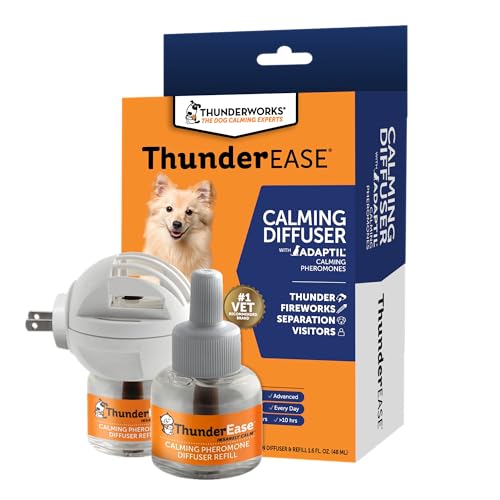
ThunderEase Dog Calming Pheromone Diffuser Kit
Mimics the calming pheromones produced by mother dogs. Clinically proven to reduce anxiety-based barking, whining, and destructive behavior. Covers 700 sq ft for 30 days.
✓ Prime Check Price on Amazon →Step 5: Counter-Condition with an Incompatible Behavior
Counter-conditioning pairs the trigger with a positive emotional response, replacing the conditioned fear or excitement with calm expectation. The incompatible behavior is a behavior the dog physically cannot do at the same time as barking — most commonly "watch me" (eye contact with handler) or a "place" command (lying on a mat).
Teaching "place":
- Put a mat or bed in a specific spot. Lure the dog onto it, mark when all four paws are on the mat, treat.
- Build duration: add 1 to 2 seconds of stay before marking. Work up to 60 seconds on the mat before releasing.
- Once the dog goes to the mat reliably on cue (3 to 5 seconds latency, 80% success rate over 3 sessions), begin using it in low-arousal trigger scenarios.
- Eventually: the moment the dog sees the trigger, you cue "place." The dog's conditioned response becomes "trigger = go to mat and receive treats" instead of "trigger = bark."
This is the most powerful phase of the protocol, and the most commonly skipped. Owners often reach Step 3 or 4, see improvement, and stop. The counter-conditioning in Step 5 is what creates lasting change — it rewires the emotional association, not just the behavior.
For dogs with anxiety-based barking, a snuffle mat or lick mat on the "place" spot adds a calming physiological component. Sustained licking activates the parasympathetic nervous system and measurably reduces heart rate and cortisol in stressed dogs — this effect has been documented in multiple studies, including a 2019 paper in Frontiers in Veterinary Science.
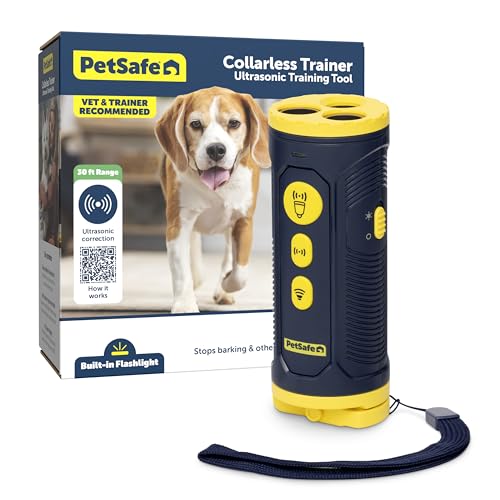
PetSafe Remote Spray Training Collar
Remote-activated citronella spray collar for training redirection. Works only when you trigger it — meaning you control when the signal appears, tying it to specific unwanted behavior.
✓ Prime Check Price on Amazon →Step 6: Build Duration and Real-World Generalization
Training that works in a controlled session with a helper doesn't automatically transfer to real-world scenarios. Dogs are context-specific learners — a behavior learned in the backyard may not generalize to the front yard without explicit practice. This is called the generalization problem, and it explains why so many dogs that "know" a command at home fail to perform it on walks.
Generalization protocol:
Practice Step 5 in at least 4 to 5 different locations — different rooms, the yard, a quiet sidewalk, a park at low-traffic times. Practice at different times of day. Practice with different helpers. Each new context requires 2 to 3 initial sessions before the behavior transfers reliably.
Increase the complexity of the trigger gradually: stationary person → slowly walking person → person with dog → group of people → person jogging → bicycle → etc. Each new trigger variation is essentially a new starting point in the desensitization ladder.
Maintenance matters. Once the behavior is established, practice 3 to 5 times per week (down from daily) with brief, positive sessions. Dogs that stop receiving reinforcement for a trained behavior will eventually show spontaneous recovery of the original behavior — meaning the barking can return months later if the training is completely abandoned.
The Mistakes That Reset Your Progress
Progressing too fast. Moving from 30 feet to 10 feet in one session because the dog "seemed fine" at 30 feet. Behavior can look calm while the stress response is still elevated. The cortisol spike from a near-threshold exposure can take 48 to 72 hours to fully resolve in some dogs. If your dog had a big barking episode on Tuesday, Wednesday's session should be extra conservative.
Punishing during a reactive episode. Even a verbal "no" during an aroused state teaches the dog that the trigger precedes unpleasant things from you — which increases reactivity. You are not correcting the behavior; you are adding to the negative emotional association.
Inconsistent management. Allowing the dog to bark at the window 20 times a day while you're away at work, then training for 10 minutes in the evening, is like shoveling against a tide. Each unmanaged rehearsal reinforces the behavior dozens of times more than your training session can counter. Window film, a white noise machine running during the day, or confining the dog away from trigger-facing windows are not giving up — they are part of the protocol.
Using the quiet cue as a punishment tone. If "quiet" is delivered sharply or angrily, the dog will associate the word with the owner's negative emotional state — not with the behavior you want. Keep your tone neutral, almost bored.
Expert Perspective
Dr. Stephanie Borns-Weil, DVM, DACVB, Head of the Animal Behavior Clinic at Cummings School of Veterinary Medicine at Tufts University, describes excessive barking as "almost always a symptom of unmet needs — whether that's safety, social contact, mental stimulation, or predictability in the environment." She recommends that owners rule out pain and medical causes before beginning behavioral protocols, as dogs experiencing chronic discomfort (joint pain, gastrointestinal issues, thyroid dysfunction) often display increased reactivity and vocalization. A full veterinary workup before starting a 6-week behavior program is time well spent, not wasted.
FAQ
How long does it take to stop a dog from barking?
For demand barking in dogs with no other anxiety issues, consistent extinction (step 2) typically shows measurable improvement within 7 to 14 days — provided every household member is consistent. Alert barking in moderately reactive dogs takes 4 to 8 weeks of daily desensitization sessions to reach a functional improvement (60 to 70% reduction in barking episodes). Severely reactive dogs with fear-based barking may take 12 to 20 weeks and sometimes benefit from short-term anti-anxiety medication prescribed by a veterinary behaviorist to lower the baseline arousal that makes desensitization difficult. Expect progress to be nonlinear — you will have setbacks around high-stimulus events like thunderstorms or new people visiting.
Does ignoring barking make it stop?
It works for demand barking, but only with total, consistent extinction — and only if you're prepared for the extinction burst, which typically peaks around days 3 to 5 and can be 30 to 50% more intense than baseline. Ignoring alone does not address alert or fear-based barking, because those barks are not maintained by owner attention — they're maintained by the emotional arousal generated by the trigger. Ignoring alert barking without a replacement behavior leaves the dog without any coping strategy, and the barking will persist indefinitely.
Are bark collars effective?
Shock and spray collars can suppress barking in the short term but have meaningful downsides. A 2020 study in PLOS ONE found that dogs trained with e-collars showed significantly higher salivary cortisol levels and stress-related behaviors compared to dogs trained without them — even when the collars were used "correctly." More critically, suppression without addressing the underlying trigger often produces displacement behaviors: the dog learns not to bark but substitutes lunging, snapping, or anxiety-related destruction. For demand barking specifically, citronella collars occasionally work, but they have an 18 to 25% false-trigger rate that can damage the training relationship.
My dog barks all day while I'm at work — what do I do?
This is almost always boredom/frustration barking, and it requires environmental management before behavioral training. A dog left alone for 8 to 10 hours without adequate exercise or enrichment will bark regardless of training. The evidence-based approach: 45 to 60 minutes of vigorous exercise before you leave (not a leash walk — fetch, tug, off-leash running), food enrichment toys (frozen Kongs, puzzle feeders) that take 20 to 40 minutes to work through, and a dog walker or doggy daycare on high-energy days. If barking continues despite this, a camera will help you identify the specific triggers — it's often environmental (outdoor noises, other animals) rather than pure boredom.
Can you train an older dog to stop barking?
Yes. The idea that adult dogs can't be counter-conditioned is a myth. The timeline is often longer — a dog that has been rehearsing alert barking for 6 years has a deeply established neural pathway — but the learning mechanisms remain intact throughout a dog's life. The same desensitization and counter-conditioning protocols used with puppies work with adult and senior dogs. One caveat: senior dogs (typically 9+ years) should have a full veterinary exam first, as cognitive dysfunction syndrome (canine CDS) can produce nighttime or unpatterned barking that doesn't respond to behavioral protocols and requires medical management.
What's the difference between a trainer, a behaviorist, and a veterinary behaviorist?
The titles matter significantly when you're dealing with serious problem behavior. A "dog trainer" has no regulated credentials in most states — anyone can use the title. Look for a Certified Professional Dog Trainer (CPDT-KA) at minimum, or a Karen Pryor Academy Certified Training Partner (KPA-CTP) for fear-based issues. An Applied Animal Behaviorist (CAAB or ACAAB) holds a graduate degree in animal behavior and uses evidence-based methods for complex cases. A Diplomate of the American College of Veterinary Behaviorists (DACVB) is a licensed veterinarian with a 3-year behavioral residency — the only professional who can prescribe behavioral medication. For severe anxiety-based barking, the DACVB level is worth the investment.
Should I use a "no-bark" command or "quiet"?
Use "quiet" rather than "no bark" — "no" is an extremely overloaded word in most households and dogs frequently stop responding to it. Any single, distinct cue word works. What matters is: (1) it's said once, never repeated during a barking episode, (2) it's always followed by a marker and treat when the dog complies, and (3) every person in the household uses the same word with the same neutral tone. Consistency of the cue word is more important than the specific word chosen. If you've been using "quiet" inconsistently for years, consider a fresh cue word the dog has no negative associations with.
The bark is a message — solve the message, and the noise takes care of itself.