7 Best Interactive Cat Toys in 2026 (Tested Against Feline Instinct)
Indoor cats spend an average of 16 hours a day sleeping — but the 6 to 8 hours they're awake contain a neurological pressure cooker that most owners never see coming. A 2021 study published in Applied Animal Behaviour Science found that indoor cats deprived of regular predatory play sequences showed cortisol levels up to 40% higher than those with daily enrichment, placing them in the same chronic-stress tier as shelter cats. That stress doesn't just disappear. It redirects: into overgrooming, vertical scratching, inter-cat aggression, and what veterinarians clinically call "frustration-based redirected biting" — the moment your cat inexplicably attacks your ankle on a Tuesday afternoon.
This isn't a personality problem. It's an unmet biological need.
The domestic cat's predatory drive operates on a hardwired five-phase sequence — stalk, chase, pounce, grab, kill-bite — that requires completion to produce the neurochemical payoff that makes a cat feel settled. Toys that interrupt that sequence (balls that roll under furniture and stop, feather wands held too far to reach) create frustration rather than resolution. Toys that complete it — especially with a small, soft "prey" item the cat can bunny-kick and bite at the end — measurably reduce stress-related behaviors within two to three weeks of consistent daily play.
As an Amazon Associate I earn from qualifying purchases. This doesn't affect our recommendations.
Table of Contents
- Why "Interactive" Means More Than You Think
- The Movement Problem: What Actually Triggers a Cat's Chase Drive
- Wand Toys: The Gold Standard (When Used Correctly)
- Electronic Teasers: Useful, But With Real Limitations
- Puzzle Feeders That Also Qualify as Play
- What to Avoid
- Expert Perspective
- FAQ
Why "Interactive" Means More Than You Think {#why-interactive}
The word "interactive" gets applied to everything from a $3 crinkle ball to a $60 app-controlled robotic toy, which makes it nearly useless as a category. What actually distinguishes enriching play from empty stimulation comes down to one question: does this toy allow the cat to complete a predatory sequence?
A ball that rolls under the couch after one swat is not interactive. It's a setup for failure. The cat initiates the stalk, commits to the pounce, and then the "prey" disappears — no capture, no kill-bite, no resolution. Repeat that pattern enough times and cats stop engaging, not because they're bored, but because they've learned the effort isn't worth it. Behaviorists call this "learned helplessness in play contexts," and it's far more common than owners realize.
Truly interactive toys share three structural features: variable, unpredictable movement (not repetitive loops); a soft, graspable component the cat can sink teeth into; and a size profile that fits between a cat's front paws — roughly 2 to 4 inches in length, similar to a small bird or large mouse. Research from the University of Exeter's animal cognition lab found that cats played significantly longer with prey-sized objects (3 to 4 inches) compared to larger objects, and showed complete predatory sequences 73% more often with soft-bodied versus hard-plastic toys.
The implication is practical: the tactile finish matters as much as the motion that precedes it. If your cat grabs the toy and immediately releases it, the toy is likely too hard, too large, or too smooth to satisfy the bite drive.
The Movement Problem: What Actually Triggers a Cat's Chase Drive {#movement}
Speed alone doesn't trigger feline prey drive. What triggers it is erratic deceleration — the signature movement pattern of a wounded animal. A feather moving at constant velocity across the floor reads to a cat's visual cortex as "not prey." The same feather darting 18 inches, pausing for 1.5 seconds, moving 6 inches at low speed, then bolting again reads as "mouse in distress." That specific pattern — fast burst, irregular pause, slow creep — activates the superior colliculus, the part of the cat's midbrain dedicated to tracking moving prey, in a way that steady motion simply does not.
This is why the cheapest wand toy in the hands of a skilled owner outperforms a $150 automated device with a fixed movement pattern. The human holding the wand can read the cat's body language — the lowering haunches, the tail tip twitch that signals commitment — and adjust speed, direction, and pause length in real time. A machine cannot. Electronic toys that run on loops or basic randomization plateau in engagement within two to four weeks as cats habituate to the predictable rhythm.
Height variation matters equally. Cats are ambush predators descended from animals that hunted birds and rodents across multiple vertical planes. A toy that moves exclusively along the floor misses the "aerial prey" response that produces the highest-energy, most satisfying play sessions. Flicking a wand toy up and over a cat's head at 45 to 60 degrees, then dropping it sharply to floor level, activates the full vertical tracking range and dramatically increases leap frequency — the behavior most strongly correlated with post-play calm and reduced nighttime restlessness.
Wand Toys: The Gold Standard (When Used Correctly) {#wand-toys}
For cats who are fully mobile and under 10 years old, wand toys with feather or crinkle-mylar attachments remain the category leader in every behavioral measure that matters: time to engagement, predatory sequence completion rate, and post-session behavioral calm. The critical variables are wand length (36 to 48 inches performs best — it keeps the human's hand out of the strike zone and allows realistic flight arcs), attachment weight (0.3 to 0.8 oz for realistic small-prey simulation), and material (natural feathers over synthetic, crinkle over smooth nylon).
The most common mistake is playing for too long at high intensity without allowing the kill sequence. Five to ten minutes of active chase, followed by one to two minutes of slowing the toy to a wounded crawl, then dropping it completely and letting the cat "kill" it with a sustained bite-and-kick, produces significantly better behavioral outcomes than 20 minutes of continuous high-energy play with no resolution. Dr. Mikel Delgado, PhD, a certified applied animal behaviorist and researcher at the UC Davis School of Veterinary Medicine, recommends this "hunt-catch-kill" arc specifically: "The play session should have a narrative arc the cat can complete. Ending with a small treat after the 'kill' bridges the sequence to the eating behavior that would follow a real hunt, and that chemical loop — hunt, catch, kill, eat — is what produces genuine satiation in a cat's nervous system."
After completing that kill sequence with a high-quality wand toy, offer a small protein-forward treat (0.5 to 1 kcal) to replicate the feeding phase. That four-part loop — stalk, chase, kill, eat — is the full behavioral sequence cats are wired to need.
Potaroma Flutter Pillow — Silvervine & Catnip Cat Toy
A self-entertaining kickable pillow infused with silvervine and catnip. Cats attack it, kick it, and carry it — works perfectly without any human involvement.
✓ Prime Check Price on Amazon →Electronic Teasers: Useful, But With Real Limitations {#electronic}
Automated interactive toys serve a real purpose: they let owners with 10-hour workdays provide some movement-based stimulation during the day, when the alternative is zero enrichment. The caveat is that they require rotation and retirement on a deliberate schedule, or cats habituate and stop engaging within two to four weeks.
The most effective electronic teasers share specific engineering features. Motor-driven wands with randomized pause intervals (not fixed loops) outperform rotating-ball devices in sustained engagement. The randomization doesn't need to be sophisticated — any interval between 0.5 and 4 seconds for the pause, and between 3 and 12 inches for movement distance, is sufficient to maintain the "prey-life" illusion. Speed settings that top out between 12 and 18 inches per second approximate realistic small-prey movement; faster than that and cats often switch from predatory play to a more anxious, reactive swatting mode.
Battery life is a meaningful consideration: electronic toys that die mid-session leave the predatory sequence incomplete, which is functionally the same as the ball rolling under the couch. Toys with 4+ hour battery life or USB-C fast charging (under 2 hours to full) prevent the frustration of a dead toy ending a play session abruptly.
The most important limitation to communicate: electronic toys should supplement human play, not replace it. They cannot read a cat's body language, cannot slow down when the cat is overstimulated, and cannot deliver the social bonding component that 10 to 15 minutes of direct human-led play provides. Use them between play sessions, not instead of them.

Feather Retractable Assorted Interactive Cat Exerciser
A retractable feather wand with multiple interchangeable attachments. The best option for bonding play sessions — cats never get tired of chasing the feathers.
✓ Prime Check Price on Amazon →Puzzle Feeders That Also Qualify as Play {#puzzle}
Puzzle feeders sit at the intersection of foraging behavior and play, and for cats who are less movement-driven — seniors, post-surgical cats, or those with arthritis — they deliver predatory enrichment without requiring explosive athleticism. The mechanism is different from chase toys: rather than triggering the visual prey-tracking response, puzzle feeders activate the olfactory and tactile hunting behaviors that cats use to locate buried or hidden prey.
The research on food-dispensing puzzles in cats is compelling. A 2016 study in the Journal of Feline Medicine and Surgery followed 30 indoor cats given access to puzzle feeders instead of bowl feeding for four weeks. By week two, owners reported a 70% reduction in attention-seeking vocalizations, a 65% reduction in destructive behavior, and improved body condition scores in three cats who had been overeating from boredom. The puzzles didn't replace meals — they replaced the passive delivery of meals with a 10 to 20 minute foraging session that gave cats a neurological hit of accomplishment before eating.
Difficulty calibration matters. Puzzles that are too easy (the cat solves them in under 60 seconds repeatedly) lose enrichment value within days. Puzzles with 2 to 3 levels of complexity — expose, retrieve, extract — maintain engagement for several weeks. Look for openings between 1 and 1.5 inches in diameter (sized for a cat's paw, not a human finger), with multiple compartments requiring sequential problem-solving rather than a single solution path.
For cats who are new to puzzle feeders, start with 30% of daily kibble delivered via puzzle and 70% in the bowl for the first week, then invert the ratio by week three. Cats who have never been challenged cognitively sometimes go 48 hours refusing the puzzle before engaging — that is normal extinction behavior, not a sign the toy is wrong. Don't revert to bowl feeding; place a small amount of a high-value treat (freeze-dried chicken, 1 to 2 calories) in an accessible compartment to prime the behavior.

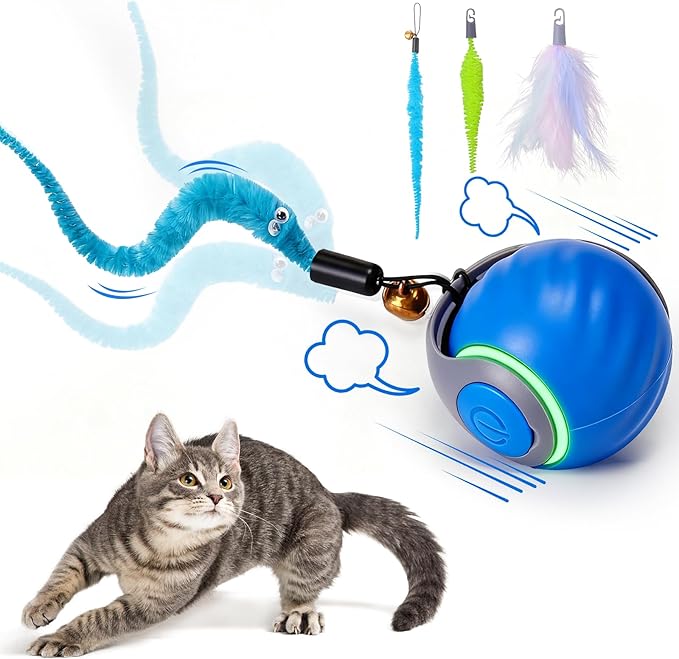
BABORUI Interactive Electronic Cat Toy Ball with Feathers
Self-moving electronic ball with erratic movement patterns that mimic real prey. USB rechargeable, auto shut-off, ideal for solo play when you're at work.
✓ Prime Check Price on Amazon →What to Avoid {#avoid}
Laser pointers without a physical toy finish. Laser pointers are one of the most neurologically frustrating toys available to cats. They trigger the prey-tracking and chase drives intensely, but the beam can never be caught — there is no tactile finish, no kill-bite, no resolution. Studies measuring cortisol in cats post-laser play (without a physical toy provided at the end) show elevated stress markers for up to 45 minutes after the session. If you use a laser, always end the session by pointing the beam at a physical toy and letting the cat pounce and bite it. Never end with the laser just turning off.
Toys smaller than 2 inches. Small components — googly eyes, small bells, detachable feathers under 1.5 inches — are choking and intestinal obstruction hazards. Cat intestines are roughly 4 to 5 feet long and will accommodate surprising objects; a small feather or plastic eye can cause a full obstruction requiring surgical intervention. Inspect toys weekly for wear, and retire any toy with loose components immediately.
Toys that make constant, loud, repetitive electronic sounds. Cats' hearing range extends to 79,000 Hz, compared to humans' 20,000 Hz. Toys that emit electronic chirping or beeping at high frequencies — marketed as "realistic bird sounds" — can cause auditory stress responses in cats even at volumes that seem quiet to human ears. Look for toys that are either silent or use recordings of actual prey sounds (validated in behavioral research) rather than synthesized electronic tones.
Leaving any interactive toy accessible 24/7. This applies to wand toys most critically, but also to puzzle feeders and electronic teasers. A toy available at all times becomes furniture. The same wand toy that produces 15 minutes of intense engagement when brought out deliberately becomes invisible after three days of constant access. Rotate toys on a 3 to 5 day cycle, storing out-of-rotation toys in a sealed bag to preserve scent novelty.
Expert Perspective {#expert}
Dr. Mikel Delgado, PhD, certified applied animal behaviorist and researcher at the UC Davis School of Veterinary Medicine, has spent over a decade studying the behavioral welfare of indoor cats. Her position on interactive play is unambiguous: "The cats I see with the most behavioral problems are almost always the ones whose owners confuse presence with engagement. A house full of toys that sit on the floor is not enrichment — it's furniture. Interactive play means a human is present, reading the cat, adjusting the session in real time, and completing the behavioral loop. Fifteen minutes of real play, done correctly, does more for a cat's wellbeing than eight hours of unsupervised access to automated toys." Delgado specifically recommends the hunt-catch-kill-eat sequence as the single highest-impact daily practice for indoor cat welfare, noting that cats who complete this sequence daily show measurably lower cortisol levels, fewer stress-related health issues, and significantly reduced rates of idiopathic cystitis — a stress-triggered bladder condition affecting an estimated 1 in 100 indoor cats annually.
FAQ {#faq}
How many minutes of interactive play does a cat actually need per day?
The evidence-based minimum is two sessions of 10 to 15 minutes daily for cats under 7 years old. Kittens (under 12 months) benefit from three to four sessions of 5 to 10 minutes, since their attention spans are shorter but their neurological need for stimulation is higher. Senior cats (10+ years) typically do well with one 10-minute session of lower-intensity play, though arthritic cats may prefer puzzle feeders over high-movement wand play. The sessions don't need to be back-to-back — morning and evening sessions that mirror feline crepuscular activity peaks (dawn and dusk) produce better results than a single long midday session.
My cat loses interest in toys after a few days. Is something wrong?
No — this is normal habituation, and it's the toy that needs to change, not the cat. Cats have an evolved instinct to deprioritize "prey" that doesn't move after repeated encounters; a toy sitting in the same spot for three days signals "not a threat, not food." Rotate toys on a 3 to 5 day cycle, storing unused toys in a sealed bag or container. Re-introducing a "forgotten" toy after two weeks often produces engagement levels close to first exposure. Spraying stored toys with catnip extract (verified: Nepeta cataria produces a response in approximately 50 to 70% of cats, with kittens under 6 months and elderly cats responding least) can restore novelty.
Are there interactive toys that work for cats with arthritis or mobility limitations?
Yes — puzzle feeders and low-height floor teasers are the best options for arthritic cats. Avoid any toy that requires jumping higher than 12 inches or rapid direction changes, which stress inflamed joints. Slow-moving wand toys kept within 6 inches of the floor allow arthritic cats to engage at their own pace. For puzzle feeders, choose flat designs with shallow compartments rather than elevated towers, as leaning over elevated surfaces strains cervical vertebrae in cats with degenerative joint disease. Confirm any significant change in activity level with your veterinarian first — reduced play interest can also be a sign of pain rather than just aging.
Can interactive toys help with aggressive cats?
Directed play is one of the most effective interventions for redirected aggression in cats, specifically because it gives the predatory drive a sanctioned outlet before pressure builds. For cats who ambush ankles or attack hands, two play sessions daily timed before typical attack windows (often morning and evening) have been shown in clinical settings to reduce redirected aggression incidents by 50 to 80% within three weeks. The key is using a wand toy long enough (36 to 48 inches) to keep human hands outside the strike zone, and never using hands or feet as play objects — that reinforces the exact behavior you're trying to redirect. If aggression is severe, consult a veterinary behaviorist before attempting solo management.
Do cats prefer feathers over other toy attachments?
In controlled preference studies, feathered attachments and crinkle-mylar materials consistently outperform smooth fabric, hard plastic, and rubber in time-to-engagement and predatory sequence completion rates. Natural feathers (guinea fowl and turkey are the most common in commercially available toys) outperform synthetic feathers in most studies, likely due to scent cues. That said, individual cats show strong personal preferences — some cats are exclusively motivated by fast-moving thin attachments, others by large fluffy objects they can full-body grab. Spending two sessions testing different attachment types tells you more about your specific cat than any study average.
Is catnip actually useful, or just a gimmick?
Catnip (Nepeta cataria) produces a genuine and well-documented neuroactive response in genetically susceptible cats — roughly 50 to 70% of the adult cat population carries the autosomal dominant gene that produces the response. The active compound, nepetalactone, binds to feline olfactory receptors and triggers a response that resembles the pheromone-driven rolling, chin-rubbing, and vocalizing behavior seen during estrus — but without the reproductive hormones involved. The response typically lasts 5 to 15 minutes and is followed by a refractory period of 30 minutes during which re-exposure produces no response. For cats who respond, catnip-sprayed toys increase initial engagement significantly, but the effect is temporary. Silver vine (Actinidia polygama) produces a similar or stronger response in approximately 80% of cats, including some that don't respond to catnip, and is increasingly available in commercial toy products.
How do I know if a play session was actually satisfying for my cat?
Post-play behavior is the clearest indicator. A satisfied cat — one who completed the hunt-catch-kill sequence — typically grooms briefly after the session (the "cleaning up after the hunt" behavior), then settles into a resting position within 5 to 10 minutes. Cats who pace, continue vocalizing, or redirect onto hands or ankles after a play session are showing signs of incomplete predatory sequence — the session ended before the kill-bite resolution. If you observe this pattern consistently, try ending every session with the toy dropping to the floor and the cat being allowed to carry it, bunny-kick it, and bite it for 60 to 90 seconds before the session ends. Adding a small 0.5 to 1 kcal protein treat after that kill-bite finish completes the neurochemical loop that produces genuine behavioral calm.
Give your cat fifteen deliberate minutes, not a room full of forgotten toys — that's the difference between a stressed indoor predator and a genuinely contented one.