The 7 Best Cat Foods for Indoor Cats in 2026 (Feline Nutritionist-Backed Picks)
Indoor cats drink roughly half the water they need when eating dry food alone — contributing to chronic kidney disease in an estimated 1 in 3 cats over age 10, according to the Cornell Feline Health Center. That statistic changes everything about how you should think about feeding a cat that never goes outside.
The indoor cat is a metabolic paradox. She lives in a climate-controlled environment, burns fewer calories per pound than her outdoor counterpart, and has no access to the prey animals that would naturally provide moisture, taurine, and arachidonic acid. But she's still a strict carnivore — one whose digestive system evolved for protein-dense, low-carbohydrate meals, not the grain-heavy kibble that dominates pet store shelves.
This article covers what indoor cats actually need, why most commercial cat foods fall short, and which formulas earn a place in a well-fed indoor cat's bowl — with specific nutritional data to back every recommendation.
As an Amazon Associate I earn from qualifying purchases. This doesn't affect our recommendations.
Table of Contents
- The Protein Standard Most Foods Fail
- Why Moisture Content Is the Most Underrated Number on the Label
- Caloric Density: The Indoor Cat Trap
- Carbohydrates, Fiber, and the Hairball Connection
- What to Avoid
- Expert Perspective
- FAQ
The Protein Standard Most Foods Fail
The AAFCO (Association of American Feed Control Officials) sets minimum crude protein at 26% on a dry matter basis for adult cats. That's the floor, not the goal. Wild felids consume prey that delivers 55–65% of calories from protein. Most indoor cat kibble lands between 30–38% protein on a dry matter basis — closer, but the source of that protein matters as much as the percentage.
The rule is simple: named animal protein must be the first ingredient. Not "poultry meal," not "meat by-products," and not "animal digest." Chicken, turkey, salmon, duck, or beef — named, specific, traceable. The reason matters biochemically: named protein sources have consistent amino acid profiles. By-products vary dramatically in taurine and methionine content batch to batch, and cats cannot synthesize taurine internally the way dogs can. Taurine deficiency causes dilated cardiomyopathy and retinal degeneration — both irreversible after a certain threshold.
Look for taurine listed explicitly as an added ingredient rather than relying solely on what's present in the protein source. A formula showing "taurine" in the guaranteed analysis or ingredient list has been intentionally fortified. Target: 0.1% minimum on a dry matter basis for adult maintenance.
The best wet formulas for protein density — pâtés and stews rather than gravies — deliver 40–55% protein on a dry matter basis. That range aligns much more closely with what a hunting cat would consume. Chicken-based pâtés consistently score highest because chicken muscle meat retains high levels of taurine through minimal processing compared to fish-based formulas, which vary by species and cooking method.
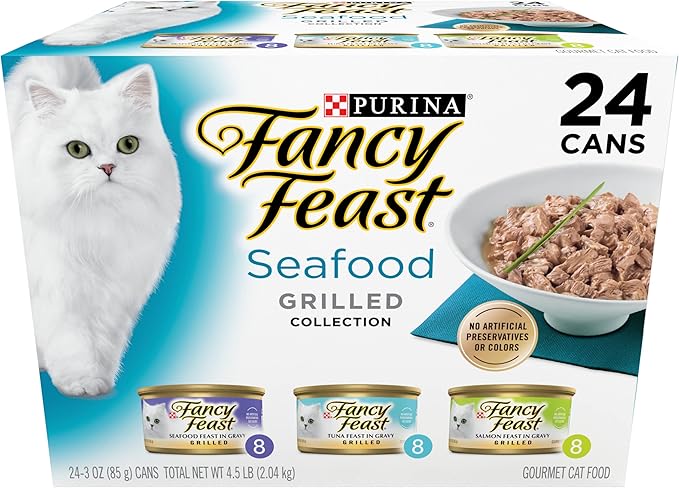
Purina Fancy Feast Grilled Collection — Variety Pack
Real grilled meat and fish pieces in a rich broth — cats can't get enough. The most loved wet cat food variety on Amazon.
✓ Prime Check Price on Amazon →Why Moisture Content Is the Most Underrated Number on the Label
Cats have a low thirst drive because their evolutionary ancestors — North African wildcats — evolved in arid environments where prey provided 70–75% of daily water intake. Domestic cats descended from these animals carry the same biology. A cat eating exclusively dry kibble may consume only 50–60 mL of water per day voluntarily, far below the 200–250 mL per day recommended for a 4.5 kg (10 lb) cat by the WSAVA (World Small Animal Veterinary Association) Nutritional Guidelines.
The downstream effects are measurable. Studies published in the Journal of Feline Medicine and Surgery found that cats fed exclusively dry food had urine specific gravity averaging 1.065–1.080 — dangerously concentrated, creating ideal conditions for urinary crystals, struvite formation, and chronic kidney stress. Cats fed wet food showed urine specific gravity of 1.025–1.040, well within the healthy range.
Wet food typically contains 75–82% moisture by weight. Dry kibble contains 6–10%. That gap is not marginal — it's the difference between a cat who is chronically mildly dehydrated and one whose kidneys are properly supported. If your indoor cat eats only dry food, her kidneys are working harder than they need to, every single day.
For indoor cats specifically — who are often more sedentary and therefore have lower water intake motivation — wet food isn't a luxury option. It's the nutritionally superior choice. If cost or convenience makes exclusive wet feeding difficult, a combination approach (wet in the morning, limited dry as a supplement) still dramatically improves daily moisture intake over dry-only feeding.
Among wet formulas, pâté styles outperform stews and gravies in moisture consistency. Gravy-style foods often have lower actual meat content — the gravy itself is largely water and starch thickeners. A pâté's moisture is integrated into the protein matrix, delivering hydration alongside nutrition rather than diluting it.
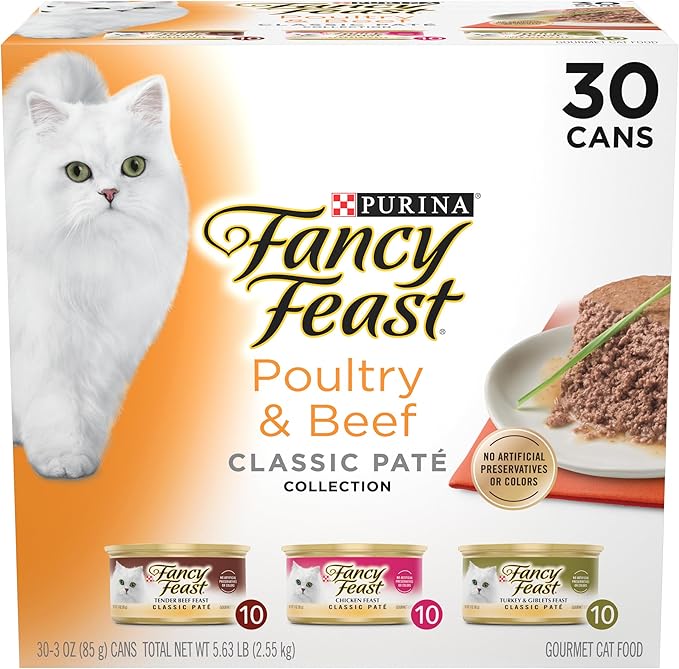
Purina Fancy Feast Classic Collection — Pâté Variety Pack
The original Fancy Feast pâté formula — smooth, rich, and irresistible to even the pickiest eaters. 24-can variety pack with multiple flavors.
✓ Prime Check Price on Amazon →Caloric Density: The Indoor Cat Trap
The average indoor adult cat requires 20 kcal per pound of body weight per day for maintenance — roughly 200 kcal/day for a 10 lb cat, 240 kcal/day for a 12 lb cat. Outdoor and active cats burn 30–35 kcal per pound. That difference accumulates fast.
The problem: most cat food formulations are designed for active, free-roaming cats. A standard dry indoor formula might deliver 340–400 kcal per cup. At a half-cup per day (already a modest serving), that's 170–200 kcal — fine for an active cat, but leaving no margin for treats, toppers, or any overestimation of serving size. Most cat owners, studies show, overfill by 20–30% when eyeballing portions.
The result is the obesity epidemic in indoor cats: the American Pet Products Association estimates that 59.5% of cats in the U.S. are overweight or obese. Excess weight in cats causes hepatic lipidosis (fatty liver disease), diabetes mellitus, arthritis, and reduced lifespan — with even a 1 lb overage on a 10 lb cat representing 10% excess body weight, comparable to a 160 lb human carrying an extra 16 lbs.
Look for formulas labeled specifically for "indoor" or "weight management" — not because the marketing is reliable, but because these tend to have lower caloric density: 280–340 kcal per cup for dry, 25–35 kcal per ounce for wet. Paired with measured feeding (by weight, not volume), they give you more room for accurate portion control.
L-carnitine is worth noting here: several indoor-specific formulas include it at 50–100 mg/kg to support fat metabolism. Research from the University of Tennessee College of Veterinary Medicine showed l-carnitine supplementation helped cats lose weight while preserving lean muscle mass during caloric restriction — a meaningful benefit given that muscle mass is already harder for sedentary indoor cats to maintain.
Carbohydrates, Fiber, and the Hairball Connection
Cats have no dietary requirement for carbohydrates. Their livers produce glucose from protein through gluconeogenesis — a metabolic pathway that runs continuously regardless of carbohydrate intake. Despite this, dry kibble formulas typically contain 25–40% carbohydrates on a dry matter basis because starch is necessary to bind kibble into its shape during extrusion. Wet food averages 5–10% carbohydrates, and grain-free wet formulas often come in under 3%.
High carbohydrate intake isn't immediately toxic to cats, but it's metabolically mismatched. Cats lack significant amylase in their saliva and have reduced pancreatic amylase activity compared to omnivores. They metabolize simple sugars more slowly, and chronic high carbohydrate intake is associated with insulin resistance, obesity, and Type 2 diabetes in cats — with indoor, sedentary cats at higher risk than active ones.
Fiber is the exception. Indoor cats need 3–5% crude fiber (dry matter basis) to support gut motility and hairball passage. A cat that grooms herself daily — typical of indoor cats who have time and tendency — ingests a significant volume of hair. Without adequate fiber, that hair accumulates in the stomach rather than passing through the GI tract, resulting in vomited hairballs or, worse, intestinal blockages.
Psyllium husk, beet pulp, and cellulose are the most effective fiber sources in commercial cat food. Beet pulp specifically is a fermentable fiber that feeds beneficial gut bacteria (Lactobacillus and Bifidobacterium species) while supporting stool consistency. Target: formulas with 3–5% crude fiber, sourced from named plant fibers rather than generic "plant fiber."
Pumpkin, often recommended anecdotally for hairballs, contains approximately 7 g of fiber per 100 g — but most cats reject it by smell. Formulas that include pumpkin or sweet potato as secondary ingredients get the fiber benefit without requiring palatability workarounds.

Purina Fancy Feast Complement Collection — Broth Topper Variety
Savory broth toppers that turn any dry food into a hydration-boosting meal. Ideal for cats that won't eat wet food on its own.
✓ Prime Check Price on Amazon →What to Avoid
"Meat by-products" as the first or second ingredient. By-products include organ meats (nutritionally acceptable), but also bone, blood, and connective tissue of variable quality. The issue isn't that by-products are inherently harmful — it's that their nutritional consistency is unreliable, and their taurine content varies significantly. If by-products appear after a named protein source (e.g., "chicken, chicken by-products"), that's acceptable. As the primary protein — avoid.
Corn syrup, sucrose, or propylene glycol. These are palatability enhancers with no nutritional value. Propylene glycol specifically is FDA-banned from cat food but sometimes appears in treats mislabeled as "cat snacks." Corn syrup in cat food signals a formula optimized for palatability over nutrition.
"Fish flavor" without named fish. Fish meal from unnamed sources is a common source of mercury and histamine in cat food. Tuna, mackerel, and swordfish accumulate mercury at higher concentrations than salmon or whitefish. Named fish (salmon, whitefish, herring) from AAFCO-compliant sourcing carry significantly lower heavy metal risk.
BHA, BHT, and ethoxyquin. These synthetic antioxidants are used to extend shelf life. BHA and BHT are listed as "reasonably anticipated to be a human carcinogen" by the National Toxicology Program. Natural alternatives — mixed tocopherols (vitamin E), rosemary extract — are equally effective and appear in higher-quality formulas.
Formulas without an AAFCO statement. The label must state "complete and balanced" per AAFCO profiles or feeding trials. "Complementary" or "supplemental" foods are not nutritionally complete and cannot serve as primary meals.
Expert Perspective
Dr. Lisa Pierson, DVM, who has practiced veterinary medicine for over 30 years and runs the widely cited catinfo.org, states it plainly: "Cats are obligate carnivores who need meat, water, and protein — not corn, wheat, rice, or soy. The bottom line is that dry food is an inappropriate food for cats." Dr. Pierson's clinical work focuses specifically on feline urinary and kidney disease, and she notes that transitioning cats from dry to wet food — even partially — is among the most impactful single interventions a cat owner can make for long-term kidney health.
Her recommended baseline for an indoor cat's wet food: minimum 50% calories from protein on a dry matter basis, moisture content above 78%, carbohydrates under 10%, and taurine listed as an added ingredient. These numbers exclude the majority of widely marketed dry cat foods from consideration as primary nutrition.
FAQ
How much should I feed my indoor cat per day?
A 10 lb adult indoor cat requires approximately 200 kcal per day for weight maintenance. Translate that to specific food: a wet food delivering 30 kcal/oz requires about 6.7 oz daily; a dry food at 360 kcal/cup requires about 0.56 cups. Always use the kcal content on the label — not the serving size chart, which is typically calibrated for active outdoor cats and will overfeed most indoor cats. Weigh food on a kitchen scale rather than using cup measurements; volume measuring overestimates by 20–30% for kibble.
Is grain-free cat food actually better for indoor cats?
Not automatically. Grain-free labeling removes wheat, corn, and rice but often substitutes peas, lentils, potatoes, or chickpeas — which are still carbohydrates, sometimes at equal or higher percentages. The FDA has been investigating a potential link between legume-heavy grain-free diets and dilated cardiomyopathy in dogs; while the evidence in cats is less established, the concern is real enough that grain-free formulas with peas or lentils in the top five ingredients deserve scrutiny. Grain-free wet food with minimal carbohydrates overall is fine. Grain-free dry food loaded with legumes may not be meaningfully better than a quality grain-inclusive formula.
My cat only eats dry food. How do I transition to wet?
Transition over 10–14 days minimum. Days 1–3: add a small amount (1 tsp) of wet food beside the dry. Days 4–6: mix wet directly into dry, 25% wet to 75% dry by calorie. Days 7–10: 50/50. Days 11–14: 75% wet, 25% dry. If your cat refuses wet food outright, try warming it to 100–105°F (body temperature of prey), which releases aromatic compounds cats respond to. Pâté textures work for more cats than chunked or shredded formats. Some cats require up to 8 weeks of gradual transition.
What's the difference between "indoor" cat food and regular cat food?
"Indoor" formulas are typically lower in caloric density (280–340 kcal/cup vs. 380–420 for standard formulas), higher in fiber (to address hairballs), and sometimes lower in fat. They may also include l-carnitine for weight management. The marketing isn't regulated — a food can be labeled "indoor" without meeting any specific AAFCO standard for the category. Read the guaranteed analysis directly: look for lower kcal/cup, 3–5% crude fiber, and named protein sources, regardless of what the label says.
How often should I feed my indoor cat?
Cats are natural grazers who evolved to eat 8–12 small meals per day from prey. In practice, 2–3 measured meals per day outperforms free-feeding for weight control — free-fed indoor cats consistently trend toward obesity because caloric intake becomes unmonitored. Morning and evening meals of wet food work well for most households. If you use dry food, a timed puzzle feeder slows consumption and provides mild mental stimulation that sedentary indoor cats otherwise lack.
Can I feed my indoor cat a raw diet?
Raw feeding is nutritionally viable if done correctly, but the risks are significant without expertise. The FDA has documented Salmonella, Listeria, and E. coli contamination in commercially prepared raw cat foods across multiple recalls. The AVMA advises against raw protein diets due to zoonotic disease risk, particularly in households with immunocompromised individuals, children under 5, or elderly people. If pursuing raw feeding, use commercially prepared formulas that are HPP (High Pressure Processed) — which eliminates pathogens without cooking — and consult a board-certified veterinary nutritionist (diplomate of the American College of Veterinary Nutrition) to ensure complete and balanced nutrition.
How do I know if my cat's food is actually working?
Key indicators at your cat's 6-month checkup: body condition score of 4–5 on a 9-point scale (ribs palpable but not visible, waist visible from above), urine specific gravity between 1.020 and 1.040 (measured via urinalysis), coat with no excessive scaling or dullness, and absence of vomited hairballs more than once per month. Long-term indicators include stable kidney values (BUN under 30 mg/dL, creatinine under 2.0 mg/dL) at annual bloodwork. If any of these markers trend poorly, diet is the first variable to reassess before attributing changes to age.
Is it okay to feed my cat the same food every day for years?
Yes, with one caveat: dietary diversity within a category (e.g., rotating protein sources across different wet formulas) reduces the risk of food sensitivities developing and ensures no single nutritional gap compounds over time. Cats can develop strong preferences for specific textures or proteins — a phenomenon called "finickiness" that's actually learned behavior, not innate — so introducing variety early is easier than trying to rotate later. Rotating proteins (chicken, turkey, salmon, duck) monthly gives the benefit of variety without disrupting established eating habits.
A well-fed indoor cat is not an expensive cat — she's an informed investment in a decade or more of healthy, comfortable life together.